
Suffering and its Discontents: Reflections on the Bronze Age Collapse
(8 minute read)
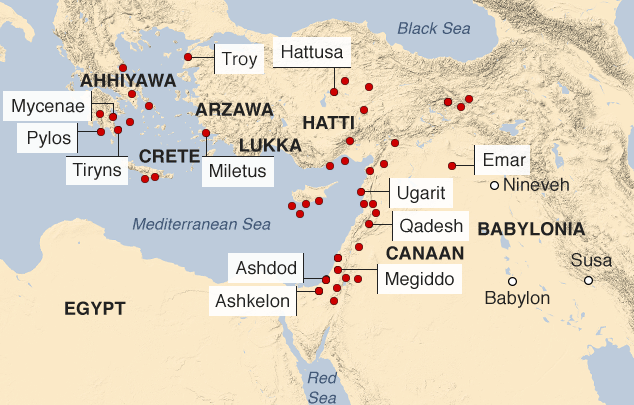
Once upon a time, there was a super-regional trade network of specialized economies that supported widespread prosperity and prolific innovation and creative output. Then the climate shifted abruptly to cause drought and plummeting agricultural yields, stateless marauders suddenly appeared on the scene, and a sequence of earthquakes crumbled cities along a major fault line. In less than one century, trade routes were severed, wealthy cities burned to the ground and were permanently abandoned, powerful governments dissolved, and refugee populations wandered the region.
That was the Bronze Age Collapse of ~1225 to ~1125 BCE. Civilization around the Mediterranean and Near East fell abruptly into a Dark Age of scarcity and bloodshed, from which it took 200 to 500 years to recover, depending on the particular region.
Societies are known to have survived acute droughts and famines in the past. Societies have survived foreign invasions. Societies have survived devastating earthquakes.
But not all at once.
If they do happen all at once, you get one of the largest-scale social system collapses in the history of humanity. Scholars suggest it was more dramatic than the fall of the Western Roman Empire.
On an individual scale, we can also note that people have been known to survive losing a loved one. People have survived being financially wiped out. People have survived losing a home or being displaced from their homeland. People have survived the cruelty of being excommunicated from their family, or the isolation of being suddenly ostracized from a social circle. People have survived job loss, being shut out of their career, and thorny legal entanglements.
But not all at once.
If they do happen all at once, you get the hyperbolic trials of Job: an evisceration of life so improbably comprehensive that it only exists in Biblical folklore to make a dramatically unsubtle point about the inscrutability of innocent suffering.
A recap of the Hebrew Bible’s Book of Job, written ~400-~350 BCE in Jerusalem:
- A man named Job loses everything at once: his children, his livestock and human slaves, his health.
- Smug “friends” of Job flail around for an explanation. They themselves have never suffered as comprehensively and profoundly as Job. They self-servingly say it must all be morally deserved suffering. But the Biblical text has gone to great pains to impress upon the reader that poor Job is impeccably righteous and undeserving of any punishment whatsoever.
- Job is left bewildered by the false accusations of the self-satisfied bystanders. Since there’s no afterlife (the Hebrews didn’t believe in one), he doesn’t even get some lame platitude about posthumous scale-balancing with which to take meager comfort. (Not too long after the Book of Job was written, Hellenistic mystery cults invented the theological platitude of individual salvation and afterlife. A sect of apocalyptic Judaism then re-branded the idea as “Christianity”.)
- God never answers the question of why Job suffers. He unsatisfyingly says (in a later interpolation appended to redeem the otherwise atheist-sounding text) to shut up and not complain or wonder about suffering.

What is obvious to today’s reader is that it is all random. There is no deity meting out good and bad fortune. Fortune is fortune. That’s why we call it ‘fortune’.
If life circumstances are coin flips, and Job’s 4th century BCE Judean village is a handful of coins, then some poor villager eventually was going toend up with a “suspicious” run of 100 tails. It is understandable that a pre-scientific village practicing immature ancient theism would flail around for supernatural explanations of something that any modern statistician knows was in reality, given the workings of randomness over enough time, expected.
The gaps of human understanding in which god(s) abide have shrunk over the two millennia since Job. Today, science obviates the psychological drive to posit a magical creator deity. We now have a causal model of the world that accounts for all of the data—including the extreme outliers like Job, whom religion never succeeded in satisfactorily explaining.
Below is a list of 25 types of personal life tragedy. How many have hit you? Simultaneously?
Just one tragedy can cause depression. Most any two in combination officially constitute ‘childhood adversity’. Three or four in combination is plenty for a dramatic memoir and motivational speaker gig. In my case, compressed into the space of 1 ½ years from 2011 to 2012, I experienced nineteen.

Nineteen types of loss in parallel—any one of which would have been the biggest thing that happened to most people in a given year. There are certainly worse things that could have happened to me, which are not checked off above. My floor is not by any means the bottom of the pit of human suffering. The onslaught was not accompanied by a catastrophic accident that permanently disabled me. Unlike my ex-husband, I do not have a mental illness. Though my physical health was affected by the turmoil, I was not diagnosed with an incapacitating or terminal illness. In the aftermath, I lost the power of free choice in soul-crushing ways; but I was not falsely convicted and incarcerated for a crime. And I am not dead. It definitely could have been worse.
Most of all, I saved my beloved puppy. That has been everything—the fulcrum of restoration, my orienting purpose and incentive to persevere. Six years on, the social isolation continues, due to my far-from-recovered economic circumstances. And, as my now-aging dog’s health fails, the remnant heartlessly pulls away.
You who callously and inaccurately relativize others’ suffering by saying that “everyone has problems” . . . you who flippantly dismiss pleas for help and blame victims in order to maintain the fragile plausibility of your personal narrative of meritocracy . . . you who pay lip service to lofty liberal activism, but refuse help to a friend facing existential risk at home . . . you whose preoccupation with one or two personal setbacks displaces your capacity for empathy . . . You are the “friends” of Job.
Most people—because they have checked “only” two or three boxes at once and were leveled by those events—cling to a worldview that life is supposed to be fair and pleasant. Theistic language or not, that is what they believe and express and act in accordance with. Their words reflect faith in mean reversion and a vague expectation that overwhelming suffering resolves eventually in compensatory hidden benefits and fairness.
People have four options for response to a friend’s suffering. (See table below.) It is a rare person who can acknowledge the non-relativism of unjust suffering around them and can accept that it just is . . . and then can join me in finding contentment in such a world (Type IV). I have learned to avoid people who refuse to acknowledge my experience (Type I), who reductively blame the victim (Type II), or whose price of acknowledging my experience is their unwelcome, projected darkness and stultifying pity (Type III). Die Sonne scheint noch.

The Bronze Age Collapse analogy extends thusly: In the power vacuum that was created by armageddon in the early 12th century BCE Mediterranean and Near East, new civilizations took root. People could no longer make bronze, because copper and tin deposits in the Near East are separated from one another by 2,000 miles. Such a concentrated, exposed supply chain broke as soon as anarchy cut off the trade route. So, people turned to harder-to-smelt but readily-available, single-ingredient iron . . . and then to carbon-tainted iron (a.k.a. steel)—which enabled lighter, sharper, stronger objects that greatly extended human power. Though the causality is speculative, we soon got phonetic alphabets, re-imaginations of a transcendent Ultimate, and democracy. A long half-millennium after a precipitous one-century collapse, global social development measures recovered.
Of course, we cannot know what would have happened without that tablet-wiping catastrophe. (This goes also for other catastrophic events, such as the late 5thc CE fall of the Western Roman Empire and the 14th c CE halving of European population due to plague.) The Bronze Age Collapse made warfare ubiquitous, which advantaged the physiologically stronger gender, which precipitated women’s loss of social status (which we see in archaeological evidence of societies ceasing to feed women meat and no longer burying them with the nifty artifacts that accompany male corpses). It turns out that women have not always been so maligned and oppressed, and gender equality changes have not been monotonically positive over the 100,000 years of homo sapiens’ existence. It seems that the Bronze Age Collapse may have set back not only social development several centuries but disproportionately knocked women back in a way that takes much longer to recover. Social status collapse is stickier than economic collapse.
Despite those negative consequences, today’s liberal historicism makes a temporally- and culturally-biased argument that the miserable and bloody 12thc BCE Bronze Age Collapse was, centuries later, ultimately “beneficial” in the imagined “arc” of deterministic history. When applied to the individual, that ideological perspective would insist that something “better” can also eventually, after some number of years, come out of the 21stc CE evisceration of my own life.
Nineteen. All at once. Is anybody listening?
– June 2017