
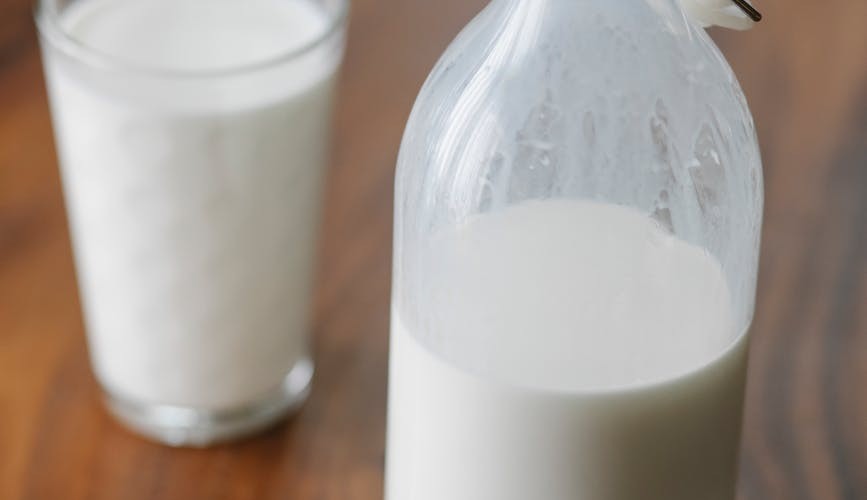
Paternalism, Autonomy, and Milk
(7-minute read)
Liberal-minded people love to ridicule the internal inconsistency of right-wing social conservatives: conservatives’ defining values are limited government, individual liberty, and privacy . . . but nonetheless one of their core goals is federal government control over private medical decisions. They deify individual choice and (the myth of) meritocracy . . . but nonetheless are also unapologetically anti-choice, giddily dooming poor pregnant women and teenage girls to lives where structural poverty obliterates individual merit.
Yet the socially progressive and/or liberal worldview (a distinction to be debated on another day) also involves a core contradiction: on the one hand recognizing that meritocracy is a myth and that poor people are not at fault for their situations . . . but on the other hand believing in the virtue of governmental control over poor people’s behavior. The liberal viewpoint recognizes the humanity of the less fortunate. It laments poor people’s limited autonomy in the face of widespread discrimination, low wages, environmental and legal injustice, inferior education, and community violence . . . but nonetheless further limits that personal autonomy via paternalistically designed welfare programs.
Recently, I opined to a fellow bleeding-heart liberal about the wisdom of cash payments to poor people in lieu of behavioral regulation via in-kind welfare. The topic has been abundantly-researched and well-documented in the media: unconditional cash payments to poor people are “surprisingly” more effective. Since gaining attention some two decades ago, the idea has spread around the globe.
My companion disagreed. When she worked checkout at a grocery store long ago, people on food stamps who had a grocery bill higher than their food stamp card balance would routinely tell her to “put back the milk”. She looked at me with a horrified facial expression, expecting commiseration.
But I am the opposite of horrified. I can easily think of numerous rational reasons to “put back the milk” in favor of boxes of processed food, beginning with this:
We heavily subsidize a food that 45% of food stamp recipients can’t even digest. Lactose intolerance affects approximately 75% of African-Americans, 50% of Hispanics, 100% of East Asians and Native Americans, and 20% of Anglos. Meanwhile, food stamp recipients are 26% African-American, 10% Hispanic, 4% East Asian and Native American, 40% white, and 20% unknown ethnicity. Multiply those numbers, and you get to about 45%.
Lactose intolerance causes flatulence, intestinal pain, diarrhea, bloating, and vomiting. Many people don’t know they are lactose intolerant, but may have a subconscious aversion to milk, drinking it medicinally because, in the swamp of endlessly-conflicting nutritional advice, many voices insist it is good for you. My Asian husband suffered intractable Irritable Bowel Syndrome for which he took medication and sometimes skipped work . . . until it dawned on us that my dairy-centric, Anglocentric meal plan was making him sick.
Rich white people wrote the economic rules, and they wrote them from their inherently non-universal perspective. Bias is invisible to those that hold it. Even as Anglo-America’s age-old faith in the virtuousness of milk has lately been shaken by science, those of us upon whose distant ancestors evolution bestowed lactase enzymes will be the last to fold. Debate over continued government subsidy of the dairy industry reflects how milk takes on moral significance in our American culture.
Other valid reasons to put back the milk:
- Kids in school. All children of parents on food stamps automatically get free milk at school, via the USDA’s 80-year-old Special Milk Program (other kids pay $0.25 to $0.65 per half pint). So, putting the milk back does not mean denying milk to kids—at least on weekdays during the school year.
- Spoils quickly. Because milk goes bad quickly and poor people are hypersensitive to food waste, they may only buy milk when they are confident that in-town schedules and custodial visits guarantee it will get used up quickly. Similar to how financial credit serves to smooth income, and layers of exquisite knotted carpets in an otherwise bare Bedouin tent serve to store wealth, so too packaged food serves to smooth food consumption. When my next payday or grocery run is uncertain, I am financially and nutritionally better off with calories stored as non-perishable food in the cupboard.
- Not filling. When food is scarce, it is rational to buy food with the highest satiety index per dollar (which is usually also the highest calories per dollar). Sadly, that means cheap carbs. We should fix food insecurity and we should fix the systemic issues making crappy food cheap—rather than expect hungry people to behave irrationally by choosing a less-filling food like milk, or expect them to take a long-horizon view of nutrition when they are trapped in a short-horizon survival game.
- Alternate source. If I check out in the grocery store with eggs, flour, chocolate, and butter, the grocery store clerk inevitably remarks, “You forgot the sugar!” (for the brownies I must surely be making tonight). Cognitive bias blinds the clerk to the possibility that I already have sugar at home. Similarly, putting milk back may mean there is already some milk at home in the fridge that should be finished first in order to not waste money. Or it may mean that cheaper milk can be gotten at a food bank, such that the food stamps are better used for non-milk items. Or it may mean that another family member with their own funds can get the milk instead.
The point is that, if you do not conduct an in-depth interview, you cannot reasonably judge such a decision to “put back the milk”.
If you are a liberal, your overarching philosophy (supposedly) dictates that you respect the decision-making capacity of individuals and recognize that nobody wants to be hungry or unhealthy. We should all cultivate sonder—a neologism defined by the Dictionary of Obscure Sorrows as “the realization that each random passerby is living a life as vivid and complex as your own—populated with their own ambitions, friends, routines, worries and inherited craziness—an epic story that continues invisibly around you like an anthill sprawling deep underground, with elaborate passageways to thousands of other lives that you’ll never know existed, in which you might appear only once, as an extra sipping coffee in the background, as a blur of traffic passing on the highway, as a lighted window at dusk.” Arms-length judgment and condescension have no place in the liberal person’s worldview.
Cash payments work better than in-kind welfare services. They are cheaper to administer and more effective at alleviating poverty. The same body of research also supports the “universal basic income” idea—a new policy darling of left-wing populists. Paying people a subsistence income frees them from taking the first dead-end job that comes along, and it enables them to make efficient investments in more productive activities. Advocates’ firm belief (supported by ample evidence) is that most recipients would not use it to sit around idly. So, we see that left-wing liberals’ inability to transfer conclusions from one domain (cash payments labelled “universal basic income”) to another (cash payments labelled “welfare”) ironically echoes the damning inconsistency characteristic right-wing ideologues.
A well-meaning friend recently bought me $40 of groceries. He chose what items to buy, paternalistically believing he knows what is best. But if I had control of $40 in cash, I would have used it at a store where it went further, and I would have bought foods that work best in my body and in small quantities that I have no chance of wasting given what is already sitting in my fridge. I would have kept some of it to fund my dying dog’s pain medication. Still, I was very grateful for the gesture and the food (including a delicious quart of milk, which I happily drink with a grateful nod to my Germanic, cow-herding ancestors!). My friend’s understandable desire for his charity money to be used efficiently ironically translated into the money being used somewhat inefficiently. Without walking in a poor person’s shoes, you simply cannot know what is best.
My emergency food stamp benefits of $194 per month can only be used in grocery stores and farmer’s markets. With $150 in free cash instead, I could get my car approved for carshare service—i.e., craft my own proverbial fishing pole, rather than depend on handouts of fish. This inefficiency of in-kind payments is what leads to people standing idly outside of low-income grocery stores, offering to buy groceries with food stamps in exchange for cash, so that they can use the cash for what the really need. Conditional welfare payments lead to economic inefficiency and gray markets. Participants lose time, money, dignity, and autonomy.
If I do not make it out of the black hole of poverty in which I now find myself, I will likely spend my last $5 on coffee rather than a final meal—buying a few crucial hours of hunger abatement and mental focus . . . and thus a last-ditch chance to happen upon a life-saving fishing pole. To a thoughtless and paternalistic observer, that dogged resourcefulness on my part may look like a stupid choice.
Another friend recounts driving past an apparently-homeless man smoking a cigarette. My friend viciously railed about how stupid poor people are, “wasting money on cigarettes that cost $12 a pack”. I railed back at how unimaginative he is, to presume that anyone smoking a cigarette had purchased it and did so without a valid reason. The smoking man could have been gifted the cigarette by a passer-by, or cleverly bartered for it, or bought it loose for next to nothing. If he bought it, it could be a once-in-forever indulgence, or a makeshift substitute for medication he cannot afford, or a strategic means of reducing gnawing hunger. Until you ask, you just do not know. The wise person—and the person whose political identity rests on belief in the complex and structural drivers of poverty and the recognition that there are hapless geniuses stuck in homeless shelters and lucky idiots inhabiting corporate board rooms—must reserve judgment.
None of this should feel so unrelatable. Nearly half of Americans will apply for a means-tested welfare program at some point in our lives. Of course, because of the stigma, many of us do not know for sure exactly who among our acquaintances and colleagues has done so. But a reasonable level of observational awareness might make it evident.
Consider that the medical field practices “paternalism in the name of autonomy”. By definition, illness involves some diminished capacity. Paternalistic medical treatments aim to restore patients’ autonomy. Physicians notoriously and admirably hand-wring over this issue, uncomfortable with the possible excesses of paternalism while also keenly focused on their mission to preserve and restore autonomy. Social policy advocates should take a page from medical ethics. It would be wise to frame paternalism in social welfare as a means to an autonomous end—and as an ethically-fraught means, to be employed only in limited circumstances and with great caution.
April 2017