
Ezekiel Bread Debunked
(5-minute read)
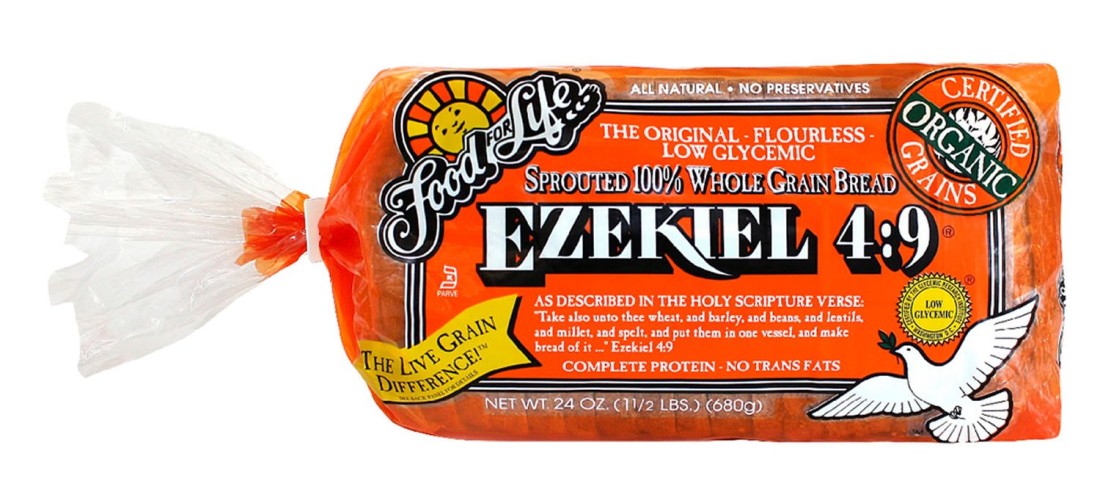
Food for Life Baking Company makes sprouted, whole-grain “Ezekiel 4:9 Bread”. The southern California-based company characterizes its product as “crafted in the likeness of the Holy Scripture verse Ezekiel 4:9 to ensure unrivaled honest nutrition and pure, delicious flavors”.
Who is Ezekiel?
According to the Hebrew Bible, Ezekiel was an ecstatic prophet of doom in 6th-century BCE Judah. Canonicity of the scripture attributed to him was controversial among Second Temple Jews. Nonetheless, that scripture was ultimately included in the Hebrew Bible. Consequently, Ezekiel is considered a major prophet in Judaism, Christianity, and Islam.
The Book of Ezekiel is filled with fanciful, proto-apocalyptic imagery. In Jewish tradition, the opening chapter’s strange, psychedelic vision is so “dangerous” that it should only be read by (male) adults. The majority of the famously-bizarre Book of Revelation in the New Testament is borrowed directly from The Book of Ezekiel (along with borrowings from the Book of Isaiah, Book of Daniel, Book of Psalms, and several extra-canonical Jewish apocalyptic scriptures).
What does Ezekiel 4:9-13 actually say?
At this point in the Book of Ezekiel, the narrator (Ezekiel) is four chapters into describing an extended religious vision, as follows:
The angry Israelite god, Yahweh, tells Ezekiel to make bread from a combination of then-common cereal grains and legumes and to bake the bread over human feces. Yahweh explains that Ezekiel’s suffering from eating this offensive bread constitutes a divine sign to all the Israelite people—symbolizing their imminent, horrific divine punishment for incomplete devotion to Yahweh. Yahweh says his wayward people will experience the demolition of Jerusalem, violent death of two-thirds of the population, foreign exile, and having to eat ritually-impure food while in exile.
In subsequent chapters of this scripture, Ezekiel goes on to preach to the Israelites that they must accept impending annihilation by the Babylonians as just punishment for their transgressions against Yahweh.
So, we read that the bread recipe in Ezekiel 4:9 is explicitly for punishment, not nourishment.
What should Biblically-accurate “Ezekiel bread” contain?
The ingredients named in the Hebrew text are as follows:
- hitta = durum wheat
- Food for Life’s Ezekiel 4:9 Bread substitutes modern common wheat
- seorah = barley
- pol = fava beans, aka broad beans
- Food for Life’s Ezekiel 4:9 Bread substitutes soybeans—which weren’t grown in the Near East / Middle East until a few centuries after The Book of Ezekiel was composed
- adasa = lentils
- dohan = probably millet. The Paleo-Hebrew word is a hapax legomenon (i.e., occurs only once in known writings), so its meaning had to be inferred by scholars from an Akkadian homolog.
- kussemet = emmer wheat, aka true farro
- Food for Life’s Ezekiel 4:9 Bread substitutes spelt, which is a softer-hulled hybrid of emmer wheat.
The Hebrew text says nothing about sprouting the above grains and legumes. Historically, pre-soaking has indeed been a useful technique to make edible food from unmilled grain. But the Hebrew text does not specify whether to mill any of the bread ingredients or keep the grain whole (in which case one might argue that pre-soaking—and thus sprouting—could have been implied in the understanding of a 6th-century BCE Near Eastern audience).
The Hebrew text also says nothing about yeast or salt, which are ingredients in Food for Life’s Ezekiel 4:9 Bread.
Health claims
Commercial Ezekiel bread is certainly healthy . . . but not because it follows a (misinterpreted) 2500-year-old Bible verse.
First, commercial Ezekiel bread does not contain any additives or preservatives—which is why it is sold in the refrigerated section of grocery stores. It is widely understood that this is indeed healthier than the alternative (though impractical for mass distribution and feeding the planet).
Second, commercial Ezekiel bread incorporates some “ancient grains”. The grains commonly cultivated thousands of years ago were displaced by much higher-yielding, hybrid grain species that tolerate a wide range of climates and require less processing effort. Indeed, such critical innovation in crop science (combined with irrigation) made possible the past few thousand years of rapid human civilization growth. Today, wealthy Westerners are re-discovering “ancient grains” because they are tasty and because some contain little or no gluten protein (though Ezekiel 4:9 Bread is not gluten-free). However, from a sustainability perspective, we must consider that lower-yield crops leave a higher carbon footprint, producing less food output per unit of energy and land area.
A contemporary bread recipe incorporating “ancient grains” may merit some claim of relative healthfulness. However, a bread recipe using those relatively high carbon-footprint ingredients—and baked (if we are to follow the Biblical text) using smog- and carbon-emitting excrement combustion—cannot feed the world. Such a recipe neither reflects lost natural wisdom nor evidences divine knowledge about human nutrition. (Moreover, note that Hebrew biographers of Yahweh did not record him ever mentioning the gluten-free “superfood” gluten-free grains of amaranth or teff, even though those were thriving crops in the Americas and Africa during Biblical times—a puzzling omission by an allegedly-omniscient deity.)
Third, commercial Ezekiel bread contains whole grains. Throughout human history, coarse foods were for poor people and refined foods were for rich people. However, humans have very recently realized that whole grains are actually more nutritious than refined grains (i.e., where the bran and germ have been removed). In a relatively abrupt reversal of millennia of food economics, whole-grain bread is now more expensive than refined-flour bread. So, if the text of Ezekiel 4:9 were to have implied use of whole grain flour (it doesn’t) or unmilled whole grains (it doesn’t), that would have been meant to convey low quality, not purity.
Conclusion
While Ezekiel 4:9 Bread is healthy (and tasty, in my opinion!), it does not really match the ingredients or process specified in the Hebrew text of Ezekiel 4:9. Regardless, the Biblical text describes a crude bread product intended as punishment for the prophet Ezekiel. If one wishes to take the Bible literally—and do so with accuracy—it is imperative to read the text through the lens of the time period in which it was written.
Consider another case of how an anachronistic reading of Biblical texts about food leads to interpretive confusion: In the New Testament’s Gospel of Mark and Gospel of Matthew, we read that, just before being crucified, Jesus declines wine (Greek: oinos) laced with bitters. That beverage sounds terrible . . . unless you know that, at that time, wine adulterated with bitter substances was used to dull pain. So, is the point of the late 1st-century CE Near Eastern writer that Jesus declines the drink because it is unappetizing (i.e., it is offered to him out of cruelty)? Or that he declines the drink because its anesthetic properties would fog his experience of suffering (i.e., it is offered to him out of sympathy)? We have no way of knowing today. Later in the same story, Jesus is offered “sour wine” (oxos) in a contextually-clear gesture of sympathy. This is also confusing for modern readers . . . unless you know that, at that time, sour wine was a common beverage perceived as refreshing.
Background on wheat species
- Einkorn wheat (aka “farro piccolo”)
Triticum monococcum
Hulled diploid wheat
Domesticated ~8000 BCE
- Emmer wheat (aka “farro medio” or “true farro”)
Triticum turgidum dicoccum
Hulled tetraploid wheat; natural hybrid of two wild grasses
Domesticated ~8000 BCE
- Durum wheat
Triticum turgidum durum
Naked (no hull) tetraploid wheat
Developed by human artificial selection from emmer wheat ~7000 BCE
5% of today’s global wheat crop
- Spelt wheat (aka “farro grande”)
Triticum aestivum spelta
Soft-hulled hexaploid wheat; natural hybrid of emmer and another unknown grass
Domesticated ~5000 BCE
- Common wheat
Triticum aestivum aestivum
Naked hexaploid wheat; hybrid of durum and spelt wheat
Developed ~1000 BCE; cultivars of this species then bred for increasingly higher gluten content
95% of today’s global wheat crop
– September 2017