
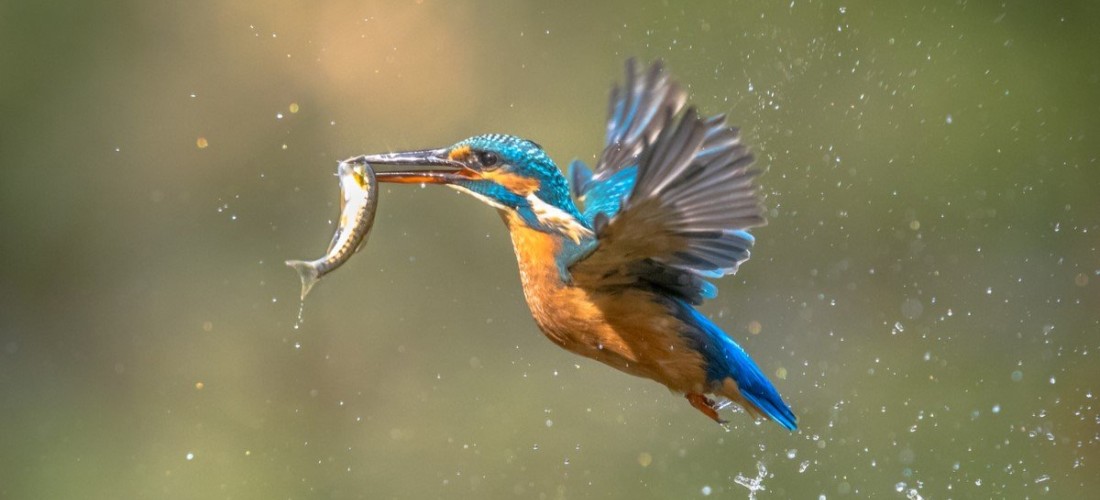
As Kingfishers Catch Fire
(3-minute read)
My favorite poem. Written in 1877 by the English poet and Jesuit priest, Gerard Manly Hopkins:
As kingfishers catch fire, dragonflies draw flame;
As tumbled over rim in roundy wells
Stones ring; like each tucked string tells, each hung bell’s
Bow swung finds tongue to fling out broad its name;
Each mortal thing does one thing and the same:
Deals out that being indoors each one dwells;
Selves — goes itself; myself it speaks and spells,
Crying Whát I dó is me: for that I came.I say móre: the just man justices;
Keeps grace: thát keeps all his goings graces;
Acts in God’s eye what in God’s eye he is —
Chríst — for Christ plays in ten thousand places,
Lovely in limbs, and lovely in eyes not his
To the Father through the features of men’s faces.
A short essay I wrote about it in high school (1989):
Of poet Gerard Manly Hopkins, Joyce Kilmer once commented that the “lavishness of his method” is appropriate to “the overwhelming greatness of his theme”. This idea is particularly true of Hopkins’ poem “As kingfishers catch fire…”. Hopkins expresses his religious beliefs concerning existence with a complex series of alliterations, assonances, rhymes, internal rhymes, and rhythms.
The poem begins with a statement as to the functions of different “thing[s]”. Hopkins says that “kingfishers catch fire”—evoking the image of sunlight playing on water and the fiery glint of a fish jumping as its scales catch the light. The poet continues with the thought that dragonflies do the same: “draw flame”. According to Hopkins, just as each stone makes a sound as it falls into a well, so does each bell produce its own pitch or “fling out broad its name”. Every living thing seems to cry out to Hopkins that it is on the earth for the purpose of doing what it does and only that: “’myself’ it speaks and spells; Crying ‘what I do is me: for that I came.’”
This entire concept, contends Ian Scott-Kilvert, is summarized in the verb “selves”. “Selving”, he explains, is equitable to the “fulfilling of individuality”, and when man engages in this process, he becomes another Christ. Hopkins himself refers to this “essential quality” inherent in everything as the “inscape”. This, perhaps, is something not unlike the “internal landscape” to which other poets refer. Hopkins concludes this poem with the idea that Christ is a part of every man and can be seen by God in “the features of men’s faces”. This philosophy, suggests one critic, is borrowed from [medieval philosopher] Duns Scotus, whose religious beliefs opposed those of St. Thomas Aquinas.
Hopkins uses many literary devices throughout the poem to weave a web of sound which captivates the listener. For instance, the first line contains three alliterations and one assonance. “Kingfisher” is alliterated to “catch”; “dragonflies” to “draw”; and “fishers” to “fire”, “flies”, and “flame”. And the “a” in “catch”, “as”, “dragon”, “draw”, and “flame” is assonant. Hopkins also uses internal rhyme—with “ring” and “string” and “tells” and “bell’s” in line three, for example. The poet has also taken liberties with diction. He created the word “tucked” from “plucked” and “touched” for the sake of alliteration and changed “selves” and “justices” to verbs. In his own introduction to an anthology, the poet refers to his rhythm as “sprung rhythm”, wherein feet contain one to four syllables and any number of “slacks”, or unstressed syllables. This style, he asserts, simulates the rhythms of common speech, prose, and most music.
This musical, tripping rhythm, as well as Hopkins’ game with words and sounds, leads both the reader and listener through the poem to the essential idea within. Hopkins uses the poetry of “As kingfishers catch fire…” to expound his idea that everything on the earth exists for the sole purpose of doing that which it does, an idea less elliptically embodied in the words: “What I do is me: for that I came.”
– November 1989