
An evening in the life of a thinking person among the masses
The electronic house music thumps underneath, in the basement. Five of us partygoers are sitting in the front parlor, away from the fray. An elliptical wooden coffee table separates us, a too-small rectangular piece of cardboard mostly covering it. One of the parlor people has been entrusted with staffing the front door (keep out the randoms, get the liability waiver signed, explain the house rules), so the homeowner host can party.
The host’s girlfriend has just rushed in to hurriedly task Front Door Guy with figuring out how to get a custom glass topper for the coffee table cut for the Host’s birthday in a month. And then she rushed off.
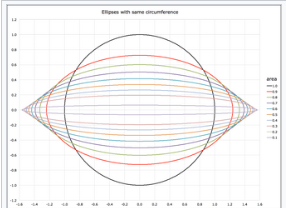
Front Door Guy has decided to just go ahead and measure the table right then and there. Excited to be useful, he busts out some string from one of his many pockets. I sit, chin on hands, gazing at the fumbling measurement being hastily taken. “Funny how there’s no equation for the perimeter of an ellipse”, I muse to no one in particular.
“Of course there is!” comes the sharp, sneering contradiction from a man sitting across from me.[1] He blurts that out instantaneously—without any time delay in which to compose his thoughts on this novel topic abruptly introduced into the party chatter…or to ask himself who I might be, sitting here across from him, or what wealth of expertise my random assertion might imply.
I don’t even acknowledge Ellipses-Have-Perimeters Guy. I don’t even look up. These days, I rarely get hot-headed enough to forget that it is futile and unfun to engage with people who aren’t inquisitive and thoughtful. I just keep placidly gazing at the ornately-carved table that came from Okinawa in the 17th century or some such story. The fumbling with strings has continued, and any minute the birthday boy Host could walk in. Occasionally, Measuring Dude asks for my finger to hold one end of a string in place while he stretches it.
Then, sure enough, the Host walks in. He is alarmed to see the cardboard topper cast aside and his table uncovered. A long conversation ensues about being careful around the antique table. The Host mentions that he’s been meaning to get glass cut in the shape of the table. Measuring Dude apologizes to the Host and replaces the cardboard topper.
Once the Host retreats back into the party, I giggle sympathetically with the others, “Uh oh, now he knows! Too bad we couldn’t keep it a secret like his girlfriend asked.” But Measuring Dude assures the room that there’s no problem, “He doesn’t know anything.”
I’m legitimately confused what he means. “How could he not know what we’re up to, when he just saw us measuring the tabletop?”
Measuring Dude snaps at me, “Are you retarded?”, and turns back to the group. He’s standing over the table now, babbling about how “it’s all good”, that the Host knows nothing about the Glass Topper Plan. He wants to preserve his identity as the Reliable Guy, to have succeeded in the Mission with which the Host’s Girlfriend had entrusted him. I just tune him out, more entertained by the kitchen counter behind him, where a cat saunters across a platter of raw vegetables, dropping a slug of drool into the dip.
The wife of Ellipses-Have-Perimeters comes to my defense, chiding Measuring Dude, “Did you really just say that?!” But Measuring Dude doesn’t acknowledge her. And I, too, ignore the issue and move on.
All day I walk through the world as a woman, fielding sexist barbs and facing the choice whether to make a big deal or not. Tonight, a few minutes ago, I didn’t care to explain geometry. And now, I am not going to explain how, once someone walks in on you measuring their table, they now know you were measuring their table.
My chosen docility works so well that Measuring Dude forgets to be embarrassed about calling me retarded. When I leave the party, he offers to be my date for the next party.
The next day, I confer with a male friend also from same Ivy league school. He tells me that he has literally never been called retarded in his life. Of course, one wouldn’t expect him to be called retarded – he’s a highly-educated professional.
But then, why do I get called retarded? Dozens of times in my life. (And, it’s many more times than that — if you include the people who knew enough not to use that slur against the developmentally disabled, and you count how many times a man has tossed off any kind of sneer against my intelligence). Usually it’s in a situation like this, where I’m innocently trying to understand the logic behind a stupid person’s thought scramble.
~~~
In the kitchen at the house party (always the center of gravity of a house party, no matter how much a host tries to avoid it), I run into a woman who introduces herself to me as “Senen”. Intrigued by the beautifully unusual name, I ask after its origin. She says her parents intended to name her “Senem”, but the nurse mistakenly wrote “Senen” on the birth certificate. Her hippie parents liked the creative mistake and rolled with it.
“And what was the origin or meaning of ‘Senem’?”, I continue.
She explains that it’s from the Bible. “Some place that Jesus passed through”, she waves her hand to say it’s not that important to her.
But I’m surprised and skeptical that there could be a placename in the Bible that I haven’t heard of. “I wonder if it’s maybe Hebrew? From the Old Testament? It doesn’t sound Greek…” There are a ton more placenames scattered through the Hebrew Bible than in the much shorter and narrowly-set New Testament—more likely that one such name could have escaped my permanent memory.
But she feels certain it’s related to a Jesus thing. And then adds that when she Googles the name, she sees lots of results from the “Middle East” (again the hand wave).
“Well, I’m super curious, so I’m going to look this up when I get home!”. I love mysteries. But, as good party guests intent on having a good time, none of us has a phone in our hand or nearby on which to do real-time research.
A bit later, I mention to Ellipses-Have-Perimeters this tantalizing mystery of where “Senem”—before its accidental transformation into “Senen”—originates. Of course, he unhesitatingly snaps back, not to miss an opportunity to correct me, “Her name is Sen-EN”.
“I know. I literally just said that.” I’ve gotten a bit irritated by this point, irritated enough to start sprinkling that lazy flare of exasperation—the word “literally”—into my speech. Time to go home.
~~~
As it turns out in the clarity of morning and Internet access, “Senem” (pronounced SEH-nem) is a common female proper name in Turkey (with an uncertain etymology, but not a Biblical one).
Further, it appears that no place called “Senem” is to be found in the Bible. The best we can do to support the Biblical origin tale of my new acquaintance’s childhood is to turn to the Book of Isaiah, where we find a similar-sounding word.
Isaiah 49:12 mentions the land of סינים (ṣīnīm; pronounced see-NEEM). In English Bibles, this Hebrew word has historically always been simply transliterated as “Sinim”. (It has been “Sinim” ever since the King James Version was produced in 1611. No English Bible ever rendered it as “Senem”.)
And what does “Sinim” mean?
In context of the Biblical text, it seems to refer to a people apparently from either to the far south or east – either of Babylon (Iraq) where the text is thought to have been composed, or of Judah (West Bank and Israel) where the text may be conceptually set. Historically, סינים (ṣīnīm) was often thought to refer to Chinese people. But more recent scholarly examination of variants of the Isaiah text has muddied the waters.
For example, in the Septuagint, the word was reinterpreted in Greek as persōn (περσῶν), i.e., “Persians”—a people to the east of the Greek empire that were perhaps more familiar to the audience of the day, and thus a better metonym for the cardinal direction of far east and/or south.
More significantly, one of the Dead Sea Scrolls[2] uses the word סוניים (ṣunīym) instead of the Masoretic Text’s סינים (ṣīnīm). Based on that Dead Sea Scroll variation from the Masoretic Text, some current English translations of the Bible now render the last word of Isaiah 49:12 as “Syene” (NRSV, ESV). And some render it as “Aswan” (NIV).[3]
However, there is a compelling argument[4] that סוניים (ṣunīym)—like סינים (ṣīnīm)—refers to Chinese people. Or at least to a people, not a place.
In summary, the name at the end of Isaiah 49:12 contextually refers to some people living far to the south or east; it has historically been assumed to refer to Chinese people; it has more recently been thought to refer to the place in Egypt now called Aswan; and today it languishes in the category of “undetermined”.
So, here is my best guess as to what may have happened to produce this woman’s name:
- Sometime in the mid-1970s, her parents remembered Biblical “Sinim”, which they had mis-read/heard pronounced as SEH-nem. And they reconstructed it phonetically as “Senem”. (Or perhaps they intended to give their baby daughter the Turkish name “Senem” but then made up a different story later.)
- The obstetric nurse misheard the last sound and wrote down “Senen”.
- Then, although Senen’s parents apparently had in mind an Old Testament Hebrew word, Senen herself proceeded to live several decades of life under the impression that her name referred to a New Testament place visited by Jesus (i.e., in the 1st century CE, in modern-day Israel or Palestine) …
- …until Senen ran into me, perched against a kitchen counter with a cup of chilled sake in my hand, at a Denver house party one Saturday night in the early autumn of 2021.
~~~
The common thread between these two interactions at a house party is that people are not thinking carefully.
To me, this feels to me like the whole world. Most people seem habituated to only think about things at a surface level…yet with aggressive confidence in the absence of actual knowledge or expertise. They are desperate to be right, to focus on what they wish were true about the world, to not ask questions. And people so often argue from the basis of narrow personal experience and hearsay, but recklessly extrapolating to describe the universe. At the root is the preference for and pursuit of instant gratification—in the context of conversation and knowledge just as in the more commonly lamented realms of food and sex.
(Denver, September 2021)
Appendix – Versions and translations of Isaiah 49:12
- Masoretic Text
(1st to 9th-century CE edition of the Hebrew Bible. The Hebrew Bible’s now-lost original content had been composed over the course of the 7th to 2nd centuries BCE. The portion of the Book of Isaiah where verse 49 is found is thought to have been composed in Babylon in the 6th-century BCE.)
All English translations of the “Old Testament” are based on this Hebrew text; in isolated places, some English versions substitute word variations from the Septuagint or Dead Sea Scrolls—where they are considered more authentic or when they support a translator’s theological agenda.
אלה מצפון ומים ואלה מארץ סינים
“these from the north and from the sea, and these from the land of the Sinim”
The word tsafown literally meant dark/hidden/gloomy and is used extensively in the Hebrew Bible to refer to the region north of a place. From the perspective of Canaan and Babylon, “sea” (yam) was a figurative way to refer to the west. So, then, ‘eretz ṣīnīm had to refer to the east and/or south.
2. Septuagint
(1st-century BCE translation into Greek of a now-lost 3rd-century BCE edition of the Hebrew Bible)
Now understood to be a less-than-faithful translation of the original Hebrew text.
οὗτοι ἀπὸ βορρᾶ καὶ θαλάσσης, ἄλλοι δὲ ἐκ γῆς Περσῶν.
“these from north and sea, others out of the land of the Persians”
3. Latin Vulgate
(4th-century CE translation into Latin of a now-lost edition of the Hebrew Bible close to the Masoretic Text)
et ecce illi ab aquilone et mari et isti de terra australi
“and behold these from the north and from the sea, and these from the south country”
4. Great Isaiah Scroll from Qumran
(~100 BCE edition of the Hebrew Bible)
The last word in the verse is written סוניים
“these from the dark and from the sea, and these from the land of the Suniym”
or “these from the dark and from the sea, and these from the land of the people of Sin”
[1] I have since tested this scenario on female and male friends of mine. Their respectful responses have included: “Yes, it is interesting that you can only define it with an infinite series”; “Hmm, I don’t know enough about math to follow what you just said”; and “Wow, tell me more!”. But those people all know me. They know that I know stuff. To them, I am not a random chick at a party, who is not the default imagined source of knowledge in our society.
[2] The “Great Isaiah Scroll” (1QIsaa) was discovered in 1946 in Qumran, and first studied in the 1950s. It contains a nearly intact copy of the Book of Isaiah, with several intriguing variations from the Masoretic Text.
[3] They get there by reading the unpointed word סוניים as ṣevenīym (rather than ṣunīym, where the semi-vowel second letter is read as a vowel instead of a consonant).Then they interpret ṣevenīym as being the Hebrew rendering of the ancient Upper Egypt city of Swen, by (speciously) relating it to another toponym in Ezekiel 29:10. The Egyptian placename “Swen” was Hellenized as “Syene”[3] (Συήνη; pronounced suh-EH-neh). Later, when the Arabic language emerged around the 4th century CE, Arabic speakers morphed “Swen” into “Aswan” (أسوان |’aswān), which is what that place continues to be called today.
[4] https://www.ao.net/~fmoeller/qum-41.htm#41:12