
A new variant of climate denialism is coming from inside the house
[20 minute read] Climate denialism has changed its clothes. On my London-Dubai flight to COP28 in November 2023, the seat next to me was occupied by a climate denier — an American man who explained that his small NGO had attended 22 annual COPs in protest of global action on climate. I did not care to sully my happy trip by engaging too deeply with this neighbor in close quarters; but a brief chat revealed that, while in long-ago years he had disputed whether burning fossil fuels even causes radiative forcing, he was now on a more focused mission to protest the cost of the ongoing energy transition.
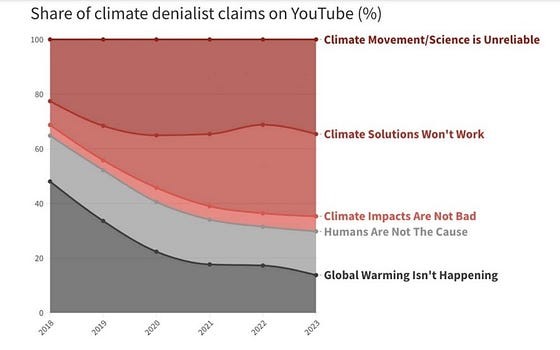
As empirical evidence of anthropogenic climate change has mounted over the years, it is now only the most fringe voices who still dare to deny reality. Meanwhile, analysis of social media content suggests that a lot of climate denial has shifted to more subtle forms. Today’s deniers do not deny that climate change is happening or that it is anthropogenic. Instead, they may claim that we do not yet have the right solutions or that we do not need to respond to climate change so urgently.
Figure 1: New variants of climate denialism (Center for Countering Digital Hate, January 2024)
The new variant
Media coverage of the climate crisis has increased, science journalism has improved, and climate is now a household topic — discussed widely by laypeople, given that every person on the planet is a stakeholder. In parallel, the professional world of climate response has enlarged, reaching to fill net new seats with outsiders from domains other than climate and energy. And then there is a large volume of would-be climate workers clamoring at the gates, wishing to transfer into a space that seems hip and lucrative; but the arrivistes often present with an underwhelming level of science literacy, analytical affinity, and domain knowledge.
Thus, while we have long been saying that “every job is a climate job now”, a corollary to that is the resulting internal education challenge. All too often, transfers from other industries and those newly wanting to work in our field lack awareness of the 30-year history of millions of experts around the world working on climate policy, climate tech, climate finance, climate research, and climate action.
When a person just starts paying attention to a conversation, they can mistakenly feel that the conversation is just starting. They can exhibit unfounded confidence, distrust of subject matter experts, disdain for settled facts, and a snowflakey certainty that their casual musings should be platformed as serious contributions. Such people can take up a disproportionate amount of the oxygen in the room, dilute the discourse, dumb down the conversation, and risk actually slowing down action in the field.
These people are not the climate deniers from the graph above: industry outsiders who have cynically shifted their tactic from denial of anthropogenic climate change to critique of solutions. Rather, these people are newly minted or would-be industry insiders who carry a new variant of climate denial.
Rather than “climate deniers”, let us call these people “climate derailers”.
The realization
I have seen my share of climate derailers in the corporate world, promoted into roles covering climate from professional backgrounds unrelated to it. Even in 2023 (so very many years into the energy transition), I worked with department heads at global management consulting firms who embarrassingly misused and mispronounced keywords, pitched old climate tech as frontier innovation just because it was new to them, unabashedly fumbled core technical concepts, and demonstrated less understanding about climate science and the scale of ongoing climate response than a random educated layperson who keeps up with the news. But I chose to think of those people as outliers or Peter Principle examples.
My wake-up call to the issue as a broader matter of zeitgeist came in early 2024, while serving as the Volunteer Technical Advisor on Energy & Climate for a new climate conference in Colorado. Astonishingly, I found myself as the sole individual involved in organizing the conference who had any background whatsoever in energy, environment, or climate work. This is such an audacious choice on the part of the conference founder as to seem implausible to the reader. And yet this was the situation.
To make the situation worse, I was also the only woman in the core organizing group. The intersectionality of being the only subject matter expert and the only woman led to me facing some bad behavior. Add to that some general organizational dysfunction and weak leadership, and the result was a toxic environment behind the scenes (though, outwardly, a fun and well-attended event!).
We had people planning and running this conference who could not name the primary greenhouse gases, did not know that methane and natural gas are the same thing, struggled to read graphs, could not grasp the difference between energy and electric power, thought ESG was a new thing, were not even passingly familiar with the Inflation Reduction Act, conflated CCS (one pathway to reductions of point-source emissions) with DAC (one method of atmospheric removal), were under the impression that U.S. greenhouse gas emissions are increasing, and who generally lacked foundational knowledge related to climate change and climate response — foundational knowledge that can be acquired for free in a variety of online educational programs or through some focused self-study. In too many cases, it was difficult to have a meaningful conversation on the subject, given the lack of shared understanding of even quite fundamental points, exacerbated by the hubris of unconscious incompetence.
Related to work on this conference, for the first time, I discussed climate with a large number of nonexperts from the general public: the conference founder, volunteers in the planning process, other volunteers at the event, wishful career switchers, hobbyists seeking a legitimizing public speaking slot, and many enthusiastic and curious attendees (as well as a good many top-notch industry veterans and public officials). Upon reflection, I see that, nowadays, having signed up to work on climate does not guarantee that an individual is not harboring some new variant of climate denial. Like in a horror movie, I realized that the threat is no longer so much external as it is coming from inside our own house …from the climate derailers.
An example
Let me present an extended case study of how this new variant of climate denial manifests.
A speaker in the lineup for this new climate conference tells me that “nobody has ever written about” his focus area before and “nobody is doing anything”. His focus area happens to be food waste (as of a year ago, when he made a career pivot). And in the context of a climate conference, he is newly thinking about the climate impact of food waste. A worthy topic, we agree.
Surprised to hear that he is somehow not aware of the literature and work on the topic, I offer to send him some names of resources. He’s interested. I email him a short list.
Some weeks later, just two days before the conference, he fires off an email — a diatribe addressed haphazardly to me and six other volunteers — , alerting us to the “oversight” that food waste has been conspiratorially “omitted” from the pie chart below that will be presented at the conference.
Astoundingly, his email mis-cites (with a footnote! from one of the sources that I had brought to his attention!) a figure of “42%” as the portion of total U.S. greenhouse gas emissions that allegedly come from “food waste and transport costs of food”. Despite having made that up, he writes “I’m not making these statistics up.”
Well… the climate impact of food waste has of course been written about. It is not missing from the State of Colorado’s emissions inventory or from the pie chart. And it is by no means 42% of the problem.
Nonetheless, the conference organizer, himself a climate derailer, reflexively backs up this guy (and confirms his allotment of a speaking platform).
Let us review the specific areas of confusion in some detail:
A. Work in progress. The suggestion that “nobody” is writing or doing “anything” on this topic is belied by a few keystrokes in a web browser. Landmark books have been written on food waste (Jonathan Bloom’s 2010 “American Wasteland” and John Mandyck’s 2015 “Food Foolish” come to mind). The Natural Resources Defense Council has a dedicated food waste team, which does all kinds of advocacy and publishes research reports on the environmental impact of food waste. Project Drawdown has done seminal work on the topic. The US Department of Agriculture has long worked on and reported on the issue. There is a Food System Economics Commission, a consortium for Transforming Urban Rural Food Systems, a Food and Land Use Coalition, and a UN consortium for Food, Agriculture, Biodiversity, Land Use and Bio-Energy. The latest IPCC assessment report addressed the food system contribution to climate change, and there was a dedicated food systems day at COP27 and COP28 (with one outcome of the latter being that Nationally Determined Contributions must call out food and agriculture emissions). In a cursory search of a science journal database, one finds 844 academic papers on food waste from just the past 12 months.
B. An important 1.3% of the problem. The preposterous 42% figure comes from a 14-year-old EPA report, wherein “provision of food” accounts for 13% of U.S. GHG emissions[1] (while “provision of goods” accounts for 29%, and the remaining 58% of emissions comes from the other human life activities of heating and lighting our buildings, using devices/appliances, getting around town, and taking trips).[2] And what part of the 13% number for the food system corresponds to food waste? The report does not estimate that; but, even if one imagines the food system to be extremely wasteful, it is obviously no more than a single-digit number.
The U.S. EPA’s 2021 report on food waste (and its extension in 2023) directly estimates GHG emissions from food waste, putting the figure at 170 million tons CO2e. In 2021, that equated to 2.7% of total U.S. GHG emissions. The EPA further estimates that it is ultimately reasonable to halve food waste in the system (considering that no physical system can entirely avoid losses). Thus, we could expect food waste reduction to reduce total U.S. GHG emissions by about 1.3%, or about 80 million tons CO2e annually across the country. And thus, decarbonization of the food system itself (i.e., that 13% of today’s U.S. total emissions) occurs primarily through decarbonization of transportation, agricultural practices, electric power production, and industrial activity.
Eighty million tons of CO2e is nothing to sneeze at. The small things add up, and all of it must be solved. However, for proportionality, let us keep in mind that there are some 1 billion tons CO2e at stake in accomplishing passenger EV adoption nationwide and another three-quarters of a billion tons at stake in closing the U.S. coal plants that were still operating as of 2023.
Figure 2: Sources of greenhouse gas emissions in Colorado in 2020 (Colorado 2021 Statewide Greenhouse Gas Inventory)[3]

C. Sources vs systems. In any pie chart depicting emissions by source, one sees categories similar to those in the graph above: Industrial activity; Transportation; Electricity production; Building operations; Livestock/agriculture/land use. Sometimes these categories are each bounded a bit differently or divided up into more granular slices. Sometimes not.
In contrast, in an entirely different pie chart that were to aggregate emissions by holistic, cradle-to-grave systems, one would see very different categories — such as “Food” (including loss and waste within the food system, if one made the analysis that granular), “Fashion”, “Electronics” …and perhaps “Conferences”. In a systems-level view, each emissions category aggregates all parts of the economy associated with fulfilling a particular need. For example, “food system” emissions include all emissions associated with growing, harvesting, processing, packaging, transporting, storing, distributing, consuming, and disposing of food.
Table 4 of the 2009 EPA report discussed above maps food emissions sources to systems-level emissions. According to that data, on our State of Colorado pie chart above, food waste would theoretically[4] constitute just 6% of the Livestock/agriculture/land use slice, 2% of the Electricity slice, 1% of the Transportation slice, and 0.1% of the Industrial slice. In other words, it would not be visible on our graph.
Look, the desperate wish for the data to match one’s dearly held personal opinions is understandable. But it is simply not acceptable.
A better tack for the food waste evangelist would have been a humble, live, one-on-one conversation with me. Beginning with something like, “I don’t think I see my Thing called out on this graph… could you please help me understand where it shows up in greenhouse gas inventories?”
I would have reiterated to him in person what I had already explained to him in writing weeks earlier: First, in an inventory of GHG sources as depicted in our pie chart above, food waste emissions constitute a tiny bit of each of several slices. Second, the climate impact of food waste is small relative to some of our conference’s big-impact themes. Third, there are important reasons to reduce food waste beyond the GHG emissions reduction potential; and focusing your startup pitch and conference remarks on those benefits may be more useful than overreaching to invent climate impact an order of magnitude higher than reality.
And a better tack for the conference organizer would have been to respectfully listen to climate sector professionals and refrain from abetting climate derailers.
A taxonomy of inside-the-house climate denial
I propose the following working list of eight forms of climate derailing:
1. Scientific illiteracy. The bias of personal incredulity leads certain personality types to feel “if I haven’t heard of it, it must be false.” Epistemic overconfidence and lack of intellectual humility abound in lay conversations about many topics of the day, particularly when they are complex or technical, like climate.
o Example: A climate expert makes a passing referral to the global warming potential of nitrous oxide. Someone who cares about climate but has zero background in it snarkily interjects, “Yeah, I don’t think nitrous oxide is a greenhouse gas.”
o Example: A climate expert explains that limiting radiative forcing is the objective in climate action. Someone who cares about climate but has zero background in it (and who had not heard the term ‘radiative forcing’ until now) impetuously responds “no, I don’t think that’s true.”
2. Action denial. Many people seeking to get involved in climate have heard that there is a climate crisis, but they may not yet know much else yet about the topic. A resulting form of the personally incredulity bias manifests as conspiratorially tinged outrage that absolutely nobody has done anything yet — that the world is sitting on its hands …while the newcomer uniquely perceives an urgent need for action.
o Example: A climate conference organizer is shocked to realize that U.S. and Colorado GHG emissions are declining.[5] Indeed, in Colorado, emissions have been declining since 2010. And a 42% reduction by 2030 from the 2005 baseline is effectively already baked in by current policy. For a forward-looking conference, the only relevant discussion about reductions would be related to the remaining, harder-to-abate 58%.
3. Data denial and institutional distrust. Reflexively distrusting the numbers is a common stance among those jumping into the conversation cold. And if one harbors ideological distrust of institutions in one’s personal or former professional sphere, they why not automatically distrust the climate institutions (e.g., UNFCCC, IPCC, US NOAA, US EPA, national labs, universities, WEF, CAN’s 2000 NGOs, the State of Colorado’s climate office, etc.). They are undercounting, overcounting, omitting, using the wrong buckets… things assumed and asserted before even knowing the vocabulary and methodologies of what is being rejected.
o Example: A climate conference staffer (and aspiring climate sector professional) hovers outside the room where a workshop on electric vehicle adoption will soon begin. A seasoned climate expert passerby encourages him in. But the newcomer demurs, complaining that he “knows” that “EVs are worse for the environment than ICE vehicles”. Yet this newcomer turns out to have never even heard of LCAs (life cycle assessments), nor the extent of professional specialization on the topic, large body of literature, definitions of system boundaries, software tools, measurement endpoints of GHG vs human toxicity and other impacts, or the settled science around the LCA results for EVs (particularly with new battery chemistries and a decarbonized power grid — of which the newcomer also seems unaware and uninterested). Sadly, anti-EV disinformation campaigns by climate deniers have had success sowing distrust in the uncritical, uninformed minds of climate derailers.
4. Pet agendas. Having a personal and/or commercial agenda when joining the climate space invites the error of motivated reasoning, i.e., seeing one’s own solution as deserving of disproportionate attention or as unassailably great for an unreasonably broad range of use cases. People with agendas may inadvertently or willfully miscite figures and twist words to promote their case, protect an emotional attachment, or align with their previously publicly stated opinion.
o Example: The head of a carbon dioxide removal (CDR) NGO — who has never worked in energy or on hydrogen — hears a long-time energy professional explain at length the recent waning of hydrogen hopeium, as certain would-be use cases switched to an electrification pathway. The CDR guy hand-waves away the SME, curtly saying, “well, I just think hydrogen is going to be really important everywhere”. The CDR guy works in climate, but specifically on removals and not on energy transition. Someone in his position may feel sympathetic to climate tech that seems like the underdog, or know peers staking their careers on hydrogen startups, or have referenced the utopian vision a hydrogen economy in public remarks. As a result, with respect to a specific discussion (e.g., about reductions as opposed to one’s specialty of removals), even a climate insider can act as something of a climate derailer.
5. Chesterton’s fence and anti-expert attitude. If you do not understand what already exists and why things are the way they are, and if you do not cultivate radical inquisitiveness of subject matter experts, you risk not only embarrassing yourself but causing harm. Climate derailers enter the space acting like they believe the establishment is daft and blind …while some obvious solution has casually occurred to the uninformed outsider and they alone have thought of it.
o Example: An aspiring climate tech entrepreneur pays to join a pre-accelerator program to develop his startup idea: turn waste plastic back into the oil from which it was made. He has no patent or process innovation, no background in chemistry or fuels, and has evidently never done a cursory web search on the topic …because he is certain that his idea is novel and has never even been considered by the big, dumb plastics and oil companies. His mentor from the program breaks the news that pyrolysis of plastic waste has been around for a few decades. Could the process be greatly improved and widely deployed? Certainly. But only by someone who, as a first step, knows the process exists.
6. Faulty reasoning. We humans are irrational and foolish creatures. Sometimes, we are guilty of sloppy, vague, careless, internally inconsistent, hypocritical, or fallacious reasoning. And in the scramble of getting one’s arms around a new, technical, fast-moving field, it is all too common to just lose track of logic.
o Example: A conference attendee scoffs at a session about hydrogen on the event schedule, explaining that “hydrogen isn’t green because the grid is dirty”. Now, there are certainly thoughtful arguments one could pose against H2 from water electrolysis. (Is it the best use of precious electrons in certain geographies?, Is it a better decarb pathway than alternatives for the proposed end uses?, In what use cases is the round-trip conversion inefficiency defensible?, How are we doing on the cost and safety challenges of H2 transportation and distribution?, Can we manage fugitive H2 leaks and the products of H2 combustion?) But the fact that grid electricity today in Colorado has a carbon intensity of 1,173 lbCO2e/MWh (but within six years will decline to ~50 lbCO2e/MWh) is not one of them. We do not make decisions on investing in long-lived infrastructure based on current conditions that will change radically within a few years.
7. Innumeracy. Mathematical illiteracy is a problem throughout society. Perhaps an individual can stumble through professional life in some industries while struggling with arithmetic, probability, statistics, the scientific method, and being perversely proud of being “bad at math”. But innumeracy simply has no place in work on climate, where understanding things like quantitative impacts, relative scale, unit economics, rates of change and acceleration, accuracy vs precision, sensitivity factors, sampling, and margins of error is fundamental.
o Example: Our extended example above about the food waste evangelist ticks all eight boxes on this list of inside-the-house climate denial forms …including innumeracy (i.e., misunderstanding and misrepresenting something that is 1.3% of a problem as 42% of a problem, and not having the intuition to sense the mistake).
8. Participation trophies. This trend is notoriously rampant across contemporary society — that every fleeting unfiltered idea matters; that everyone’s feelings count as facts; that any semblance of effort, however lazy, ill-informed, or ineffectual, is some kind of accomplishment. Indiscriminately coddling uninformed ideas is antagonistic to timely and effective climate action.
o Example: The founder of this conference urged us to give a speaking platform on CDR to a small business doing DAC part-time in a household garage. When I spoke with the proprietors, they seemed unable to explain the capture method, unfamiliar with introductory CDR concepts (MRV, LCA, VCM, insetting vs selling credits, offsetting vs beyond value chain mitigation), and had no plans to scale beyond a few kg per year of CO2 removal (whereas the first DAC plant in the U.S. will capture five orders of magnitude more CO2 per year and still be considered “small”). They stressed their “uniqueness” due to making tangible products from the captured carbon …except that’s not a new idea. For example, the Carbon to Value Initiative has supported a couple dozen C2V startups over the past few years; and XPRIZE held a C2V competition that launched eight years ago. (In the end, we did not have a quorum of CDR investors/companies/advisors to produce a conference session on the topic, so the prospect of disseminating misinformation on this topic thankfully became moot.)
What’s the harm?
In many cases, climate derailer nonsense is no worse than annoying. These are typically people outside the industry, wishing to enter it. As a result, those who actively work on climate rarely engage with them.
But sometimes they have standing — by deciding to start up a new climate conference with a team composed entirely of nonexperts, or by being promoted into a corporate role that includes climate from a career path that did not include it. In such cases, the willingness of climate derailers to dilute the discourse can be detrimental. (Back to the Colorado conference example: As an advisor to the event, my time strained to include combating misguided suggestions and factual misunderstandings on climate topics, with little solidarity for efforts to ensure content quality and a discussion level capable of producing impact.)
Climate denialism has been the reason that humanity has only started taking action at a meaningful scale in the past decade, despite the causes and risks of anthropogenic climate change having been known for at least a century, and despite global action having been discussed for some 35 years.[6] Today, the path to reduce emissions in time to avoid the worst effects of climate change is dramatically steeper than if we had acted earlier. So, the potential harm from new variants of climate denialism — including climate derailing — is significant.
Taken a few steps further, lack of intellectual humility, curiosity, and rigor can lead to some pretty crazy endpoints. For example, have you heard of the “weather modification” folks? In the political sphere, recall how a conspiracy narrative of federal election “rigging” began as one utterance in August 2020 and a few months later had captivated 34% of the U.S. population. Dumb stuff can cause great harm rather quickly. An epistemic divide can be more damaging than an ideological one. This is serious business, and people have thought a lot about the prevalence of anti-intellectualism and conspiracism in public discourse as of late.
That said, it is important to be extremely clear that dealing with climate derailers does not and should never involve straying into censorship. There remain many points in plans for reductions, removals, and adaptation that are not settled and where reasonable people disagree. We wholeheartedly need a culture of critical inquiry and thoughtful debate about decarbonization pathways and climate interventions. This is crucial because, not only is there timing urgency putting pressure on decisions, but also humanity has a long history of seizing upon technological solutions without recognizing adverse consequences (remember how plastic seemed like such a great idea?).
So, people need not axiomatically defer to every expert consensus. However, to challenge an expert consensus constructively, people do need a reasonable level of understanding. One has to know the vocabulary, know what exists, know how and why things came to be the way they are, and be at least familiar with the relevant science, engineering, economics, social and health impacts, market players and rules, to participate in the conversation in a useful way.
What’s to be done?
Regarding climate denialism, we are aligned on the danger, and there are dedicated resources combating it in public, in the media, and on social media (e.g., the CAAD coalition, AFP Fact Check). And so what is to be done about climate derailing, which insidiously crops up in private and internal discourse? I believe the answer is straightforward: decide that climate derailing is unacceptable, call it out when it happens, and back up the people who call it out.
This can be difficult to do from the sidelines or as a solitary minority voice. Strong, informed leadership is necessary. Lazy leaders may portray climate derailers as independent thinkers or engage in the fallacy of bothsidesism — as if a layperson’s casual ideations have the same valence as a global expert consensus or practitioner positions grounded in evidence and experience. Leaders must demand humility from the newcomers entering our field and enforce high expectations of disciplined thinking. And newcomers must “seek to understand before seeking to be understood”. Having seen years of delay in large-scale climate action, we should have learned our lesson to be intolerant of climate derailers and climate deniers alike — especially when they are inside the house.
— January 31, 2024
[1] Globally, the share of GHG emissions attributable to the food system may be higher than the U.S.’s 13%. For example, a 2021 report by the European Commission’s Joint Research Centre puts the global figure at 34%. That gap reflects geographic differences in the definitional boundary of “the food system”, in the types of domestically produced and processed foods, and in decarbonization progress.
[2] The report provides no estimate of emissions from food waste within the food provision system. It does comment that increasing the composting rate up to 50% of discarded food (from the then-current 2006 rate of 2%) could save 10m tons CO2e annually.
[3] As of this writing, the biennial update has since been published: Colorado 2023 Statewide Greenhouse Gas Inventory
[4] This is merely theoretical, given that the marginal impact of waste reduction in a system is difficult to assess. For example, if I am trucking less food to grocery stores each week because they are no longer discarding a certain volume of unsold food, at what point am I still sending the same number of trucks just with a bit less cargo volume in each shipment, versus at what point am I consolidating trucks/routes in a way that reduces total truck miles traveled and therefore the transportation-related food waste emissions?
[5] Greenhouse gas emissions in the U.S. have been slowly declining since 2007. Overall global emissions are projected to potentially start declining as soon as 2024. However, steeper declines are still needed; and, even then, what has already accumulated in the atmosphere likely continues to cause radiative forcing and rising temperatures for some time.
[6] Newspapers first reported on the global warming potential of greenhouse gas emissions from fossil fuel use back at the start of the 20th century. By 1960, increased atmospheric CO2 levels had been empirically confirmed. In the early 1980s, global scientific consensus emerged about human-caused climate warming. In 1988, the U.S. Congress first heard official testimony about the threat, and the United Nations Intergovernmental Panel on Climate Change was founded. In 1997, a first international treaty to reduce greenhouse gas emissions was initially signed by 46 nations …. and in 2015, the United States joined a global community of 194 nations in a commitment to cut emissions.